
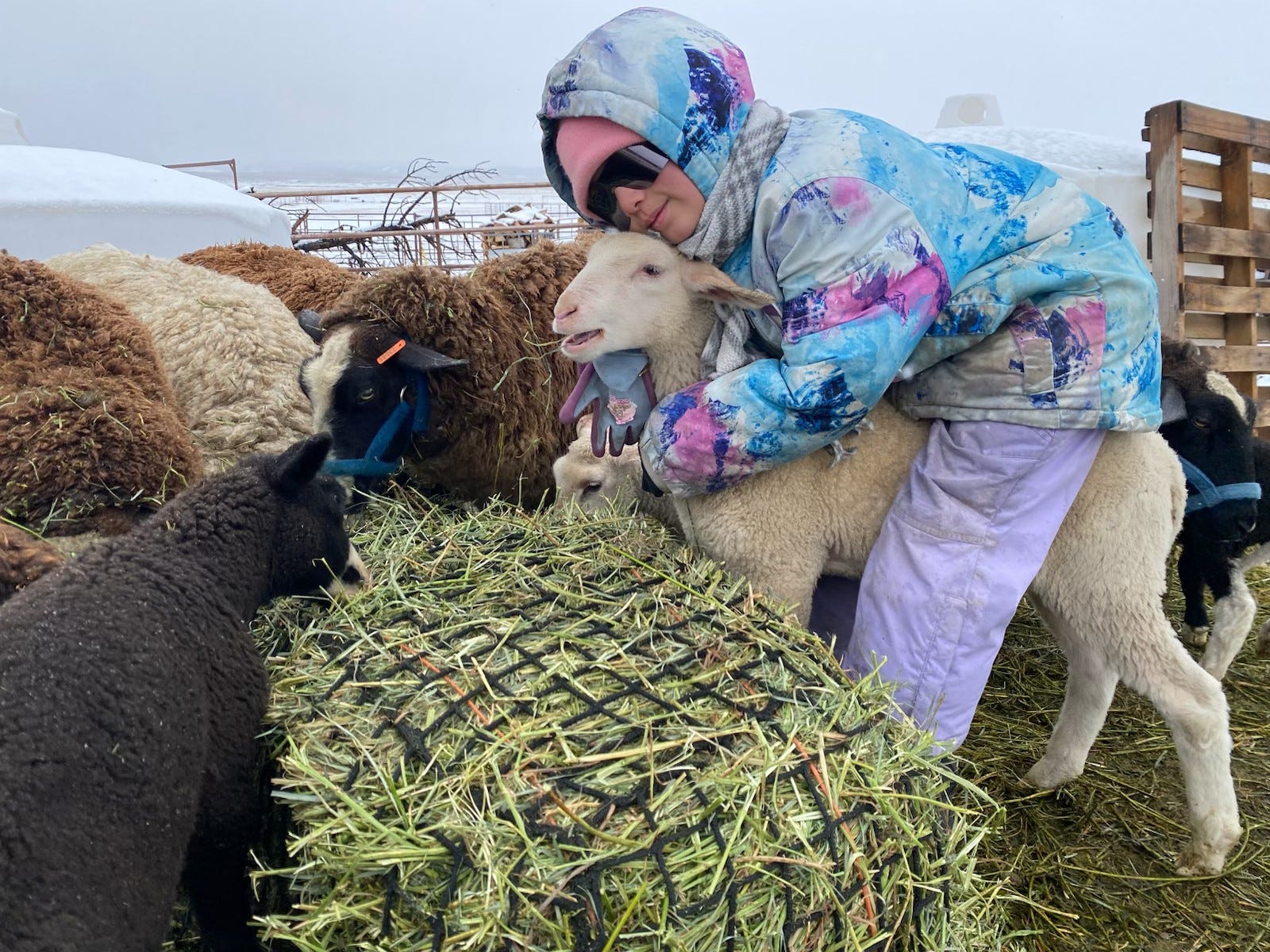
Q: How much milk does an East Frisian cross give?
A: They won't give you much on their first freshening, in my experience they usually give you 0.5-1 qt per ewe with a lamb share (I’ll explain what a lamb share is later on in this Q&A), milking once a day. From their 2nd freshening their milk production will raise up to 2-3 qt(or even more) per ewe with a lamb share, milking once a day. Please note that these estimations are based on their peak production period, which could be the first 4 months of the whole lactation period. The production rate will decrease once the lambs start to consume hay or start to graze. They'll reduce the need of their mother's milk, which significantly reduces the stimulations to the ewe's milk production unless you can start to milk twice a day to replace the lambs' stimulations.

Q: How long is their lactation period?
A: Usually 5-6 months, sometimes up to 7 months if you try very hard to keep stimulating the ewe.
Q: How many times should I milk my ewe?
A: I only milk once in the morning because I'm lazy, and I found that there won't be much milk left after the lambs spent a whole day with their mom. Also I don't want to abuse my ewes because producing milk will extract lots of energy and nutrition from their body.
Q: What is a lamb share?
A: A lamb share is a way you can start to get milk early without affecting the lamb's growth rate. I usually start to milk my ewe in a very early stage after lambing, usually starting at week 2 or week 3 after lambing (depends on the lamb's condition). I separate the lambs from the mom during the night, and milk the mom first thing in the morning, then release the lambs back to the mom to spend the rest of the day nursing.
Q: What can I do to increase my ewe's milk production?
A: Nutrition, hydration, and stimulations are the most important components that you should improve to increase your ewe's milk production. A ewe's gene is not what you can change, so we’re not going to discuss gene here. If you have experiences in breast-feeding, you must know you need to consume high-energy and high-nutrition food, drink lots of water, and nurse the baby as frequent as you can during your nursing period, because that's how your body would produce enough milk for the baby.
Nutrition, hydration, and stimulations are the most important components that you can improve to increase your ewe’s milk production.
Q: Should I hand milk or use a milking machine?
A: I have a simple pulse milking machine but I still choose to hand milk with my daughter. I like to nudge the ewe's udder frequently to stimulate her body to produce more milk, and if you've ever seen lambs nudging their mom's udder before drinking milk, you'll know what I'm talking about. So hand milking is just because I want to get the most milk out of my ewes, and hand milking is kind of rewarding (frustrating at first), but is an optional and personal choice.
Q: How long can the milk stay fresh until it starts to taste off?
A: In my experience, sheep milk cultures very easily. My kids are very sensitive to the taste of the milk, and they tend to feel that the milk tastes a bit off from day 3-4. But cultured milk can be made into cultured butter, yogurt, or cheese. Kefir might not work because the native cultures in the milk would dominate so the kefir culture would be suppressed. But freezing your sheep milk is a very good way to preserve the freshness of the milk, especially when you're trying to collect enough milk to make cheese, which might take a while.
Q: What do I do with lambs that have been rejected by their moms?
A: I'm too lazy to bottle feed lambs, and if a first time mom doesn't know how to be a good mom, I would spend a couple days, even weeks, to train the mom to naturally nurse her lamb(s). The way I do it is to leave the mom with her lamb(s) in a "nursing room"(I personally use Poly-domes), and I'll come out every couple hours to halter the mom and let the lamb(s) nurse on her, training the mom to get used to "nursing" and her own lamb(s) at the same time. It’s sometimes frustrating, but it’ll be done eventually. And I'm also helping my ewes to become better mothers. I don't do this in the middle of the night. I only do it before I go to bed, then first thing in the morning. And you don’t need to worry about hungry lambs in the middle of the night. Lambs sleeping overnight will help them grow faster.
Q: What do I feed my ewe during a milking session?
A: I used to make a "milking grain mix" using alfalfa pellets, black oil sunflower seeds, oats, and a bit of corn. A little while after using it, I found that my ewes got mastitis frequently. Then one day I had an idea. What if I took all the grains from their diet, only fed organic alfalfa pellets, and let them graze freely on our pasture? And once I did that, I found that they won’t have the chance to get mastitis without grain in their diet. By doing so it also avoid all kinds of potential toxins entering my sheep's body and their milk. e.g: black oil sunflower seeds can contain a high level of heavy metals since sunflowers absorb everything inside the soil they’re growing in. And other grains can contain a heavy level of glyphosate.
Q: Does sheep milk separate from cream naturally like cow's milk?
A: Sheep milk is naturally homogenized. It’s hard to separate the cream in one day, but it’ll float to the top in a couple days. The fastest way to extract sheep cream(and to avoid the off-flavor) is using a cream separator.