
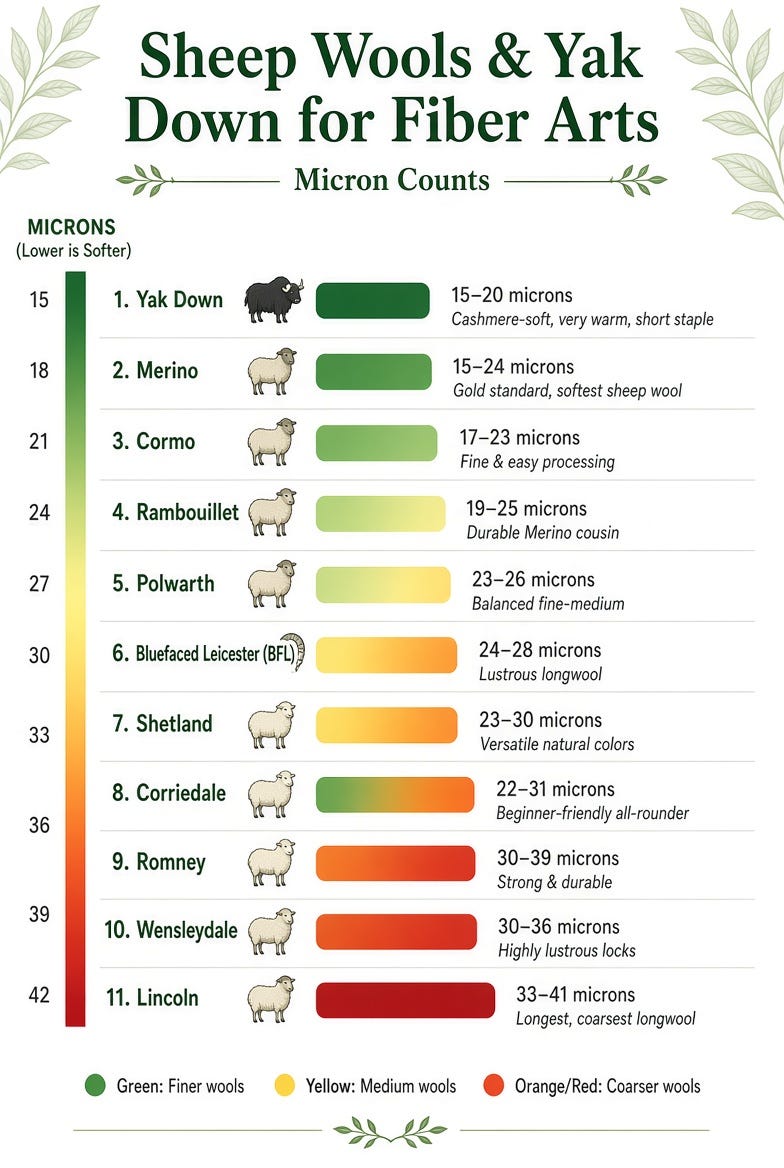
For decades, many people have associated wool with itchiness. The common explanations—wool allergy or the scaly surface of the fiber—have largely been overturned by textile science. Research, particularly from CSIRO in Australia, has shown that the primary driver of the prickle or itch sensation is fiber diameter, measured in microns (µm). When fibers are fine enough, they bend against the skin rather than poking it. When they are coarse, they trigger nerve endings and create discomfort.
The Mechanical Cause of Prickle
Prickle is a mechanical response, not an allergic one. True wool allergy is rare. What most people experience is the stimulation of pain receptors (C-fibers) in the skin by protruding fiber ends that are stiff enough to exert force without buckling.
CSIRO researchers, including G.R.S. Naylor and colleagues, established that a force of roughly 75 mg or more is needed to activate these nerves. The stiffness of a fiber end is governed largely by its diameter: thicker fibers resist bending far more than finer ones. As a result, the percentage of fibers coarser than approximately 30–32 µm is the strongest predictor of prickle. This is often expressed as the “prickle factor” (percentage of fibers >30 µm) or its inverse, the “comfort factor.”
Key supporting findings include:
Fabrics made from finer wools (around 19 µm mean diameter) were rated non-prickly, while prickle increased steadily as mean fiber diameter rose.
When acrylic fibers were blended to match the diameter distribution of wool, the resulting fabrics produced equivalent prickle sensations. This demonstrated that the effect is not unique to wool or its surface scales.
The diameter of the fiber ends (the parts that protrude from the fabric surface) is particularly important, as these are what contact the skin.
These conclusions appear in papers such as Naylor’s 1992 study on coarse fibers in acrylic blends (Wool Technology and Sheep Breeding) and the 1997 work on fiber-end diameter characteristics in single-jersey fabrics (Textile Research Journal).
The Limited Role of Surface Scales
Wool and other animal fibers have overlapping cuticle scales. These scales create directional friction and enable felting, and they can influence the perceived smoothness or “handle” of a fiber. Finer fibers and certain specialty fibers (such as cashmere or yak down) often have flatter or more closely adherent scales, which contributes to a smoother feel.
However, the scales themselves are extremely small—protruding less than one-thousandth of a millimeter. Studies have shown that chemically degrading or removing the scales (as in some superwash treatments) does not meaningfully reduce prickle. Diameter remains the dominant variable. Scales may add a secondary textural quality, but they do not override the mechanical effect of coarse fiber ends.
Practical Micron Thresholds for Next-to-Skin Wear
Research and industry practice have converged on clear guidelines:
Under ~19–22 µm (especially ≤18.5–19.5 µm): Excellent for next-to-skin use. Superfine and ultrafine Merino, fine Cormo, and high-quality yak down fall here.
22–25 µm: Borderline. Acceptable for many people in mid-layers or less sensitive applications, but may feel textured to sensitive skin.
Above ~25–28 µm: Generally not recommended for direct skin contact. Prickle risk rises significantly.
≥30–32 µm: High likelihood of noticeable prickle for most wearers. These fibers are better suited to outerwear, rugs, blankets, or structural uses.
Individual sensitivity varies, and fabric construction (yarn twist, stitch density, finishing) also plays a role. Still, mean fiber diameter and the proportion of coarse fibers remain the strongest predictors.
Implications for Common Fibers
This framework explains the ranking of popular sheep breeds and specialty fibers:
Yak down (typically 15–20 µm) and fine Merino, Cormo, and Rambouillet sit comfortably in the next-to-skin range.
Medium wools such as Corriedale and some Shetland straddle the borderline.
Longer, coarser wools (Romney, Wensleydale, Lincoln) excel in durability, luster, and ease of spinning for outerwear or hard-wearing items, but they are not ideal for garments worn against bare skin.
Handspinners often favor medium and longwools because they are forgiving to draft, produce strong yarns, and offer visual interest. Those qualities are genuinely practical for many end uses—they simply address different performance needs than next-to-skin softness.
Conclusion
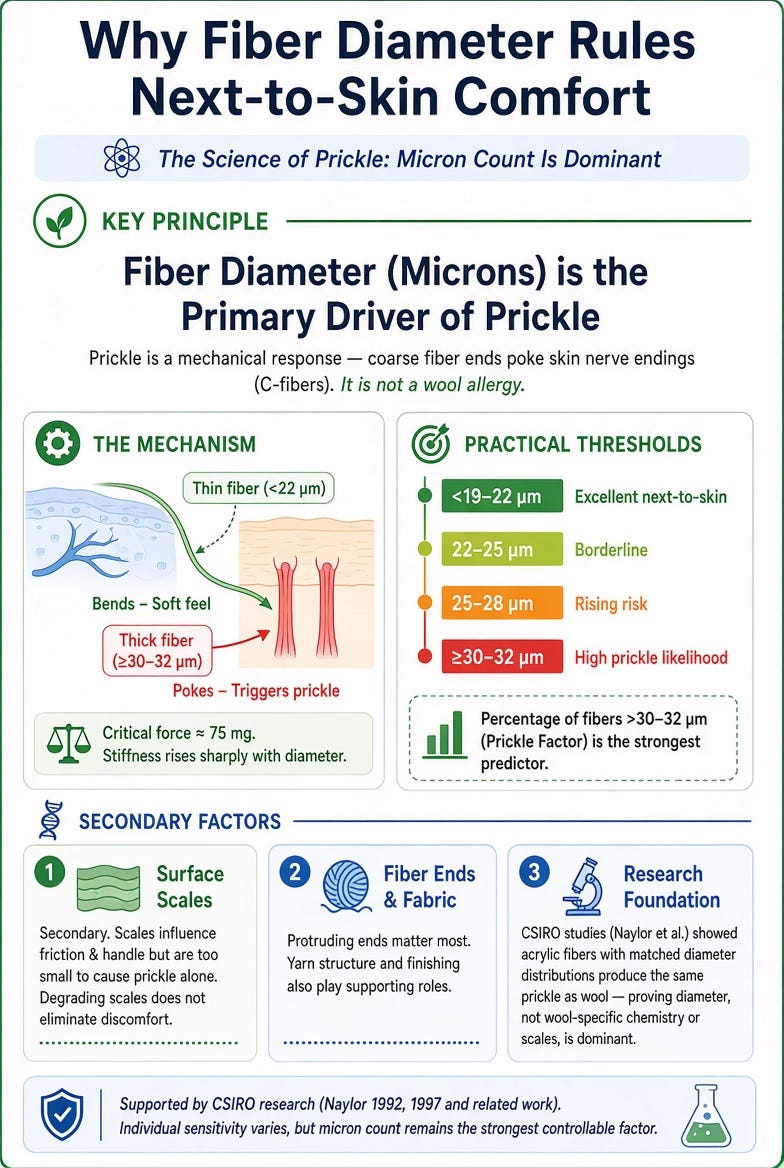
Fiber micron count is the dominant factor determining whether a textile feels comfortable against the skin. The sensation of prickle arises when coarse fiber ends are stiff enough to poke nerve endings. Surface scales influence friction and handle but are secondary. CSIRO’s systematic work in the late 1980s and 1990s, particularly the studies comparing wool and acrylic and examining fiber-end diameters, provided the rigorous evidence base for this understanding. For anyone selecting fibers for next-to-skin garments, the practical rule remains straightforward: prioritize finer mean diameters and minimize the percentage of fibers above the 30–32 µm threshold.