
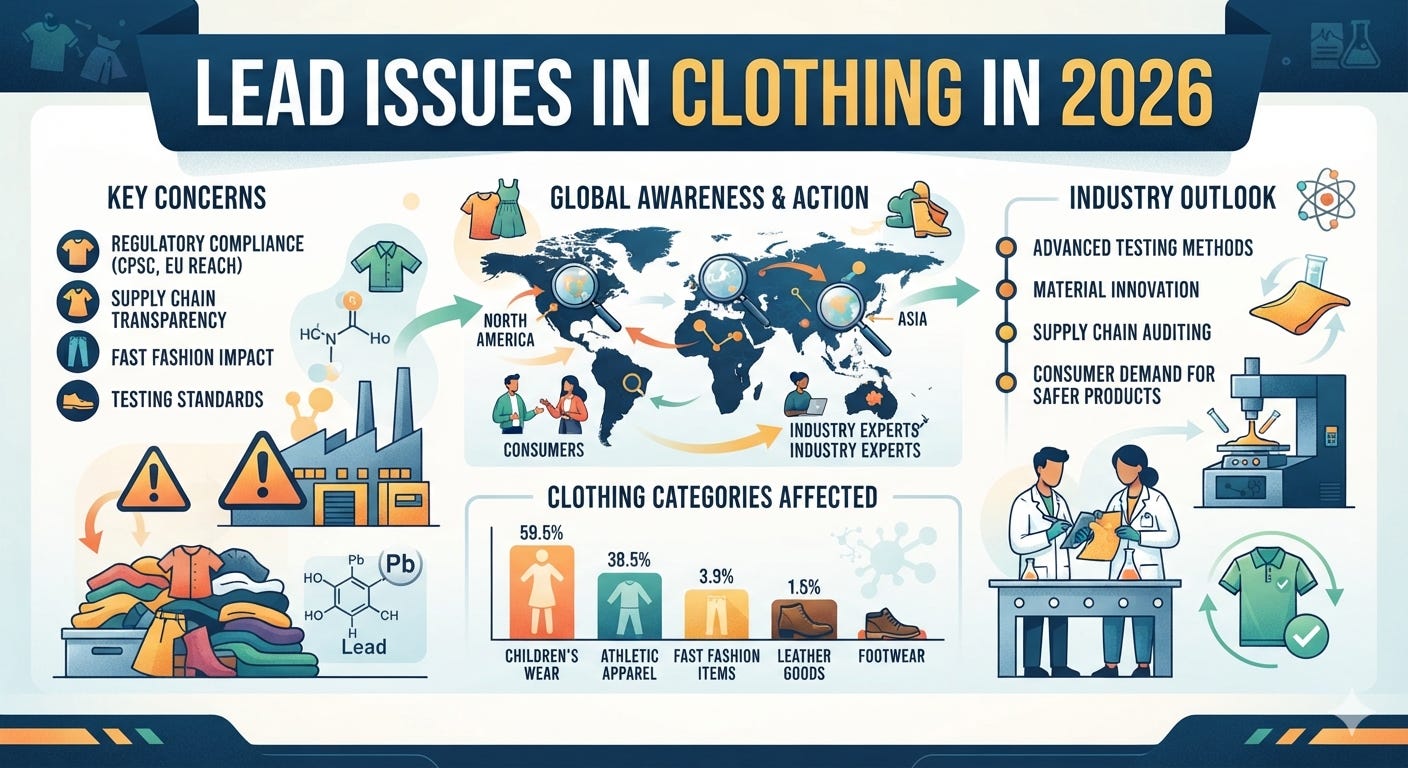
A 2026 study presented at the American Chemical Society meeting by researchers at Marian University found that every children’s T-shirt tested from discount and fast-fashion sources exceeded the federal limit of 100 parts per million (ppm) of total lead. Brightly colored fabrics showed the highest concentrations. Earlier work by the Center for Environmental Health (CEH) documented persistently elevated lead levels in handbags, wallets, belts, and shoes sold at off-price retailers such as Ross and Burlington, with more than 25 percent of tested accessories in 2022 containing levels above 0.03 percent.
How Lead Ends Up in Clothing
Lead remains a problem in apparel (clothing, textiles, and fashion accessories) in 2026 mainly due to incomplete regulations, complex global supply chains, cost-driven manufacturing practices, and uneven enforcement. There is no safe level of lead exposure, and it can cause neurological harm (especially in children), reproductive issues, and other health effects.
Sources of Lead in Production
Lead can enter via:
Dyes and pigments, especially for bright/vivid colors (reds, yellows, oranges). Some manufacturers use inexpensive compounds like lead(II) acetate as a mordant/fixative to help dyes bond and stay vibrant/long-lasting.
Metal hardware (zippers, buttons, snaps, grommets).
Leather/faux-leather treatments, surface coatings, prints, or recycled materials.
Finishing agents or contaminants in the process.
Health Risks and Who Is Most Affected
There is no safe level of lead exposure. Even low amounts can impair brain development, cause behavioral problems, and damage the nervous system in children. Adults face risks to reproductive health, cardiovascular function, and kidney function. Young children are especially vulnerable because they frequently mouth clothing and because their developing bodies absorb lead more readily.
Discount and off-price retailers, which serve a higher proportion of lower-income and racially diverse shoppers, have shown higher rates of contaminated accessories in testing. Workers in textile production facilities abroad also face elevated occupational exposure.
Limited Scope of Regulations
California’s Proposition 65 has driven significant reformulation through lawsuits and settlements, particularly for leather and faux-leather accessories, but it is a warning and enforcement mechanism rather than a nationwide ban. Other states, including Colorado, have focused recent chemical restrictions on PFAS in textiles rather than lead. Enforcement challenges arise from massive import volumes, multi-tiered global supply chains, and limited upstream visibility into dyeing and finishing processes.
Homesteading Beyond Food
Since 2025, The Dancing Yak Ranch has begun testing and producing un-dyed, naturally next-to-skin soft fiber through a true homestead, self-sufficient approach. By carefully collecting and processing the animals’ own fleece and fiber on the farm, we create pure, chemical-free yarn and fabric that stays soft against the skin while staying rooted in the land and the traditional rhythms of ranch life.
We encourage more people to explore natural fiber productions either from their own homestead or promote local fiber farm products. Also, please stay tuned for our big announcements on this subject in 2027!!


